Application Overview
Encapsulation of battery terminal connection posts presents a deceptively complex materials engineering challenge. In industrial battery storage systems, the terminal must remain fully sealed while exposed to corrosive electrolyte and withstand mechanical stresses encountered during shipping, installation, and thermal cycling over a long service life. When a fast cure is also required to integrate into a highly automated assembly process, the formulation options narrow considerably.
Challenge
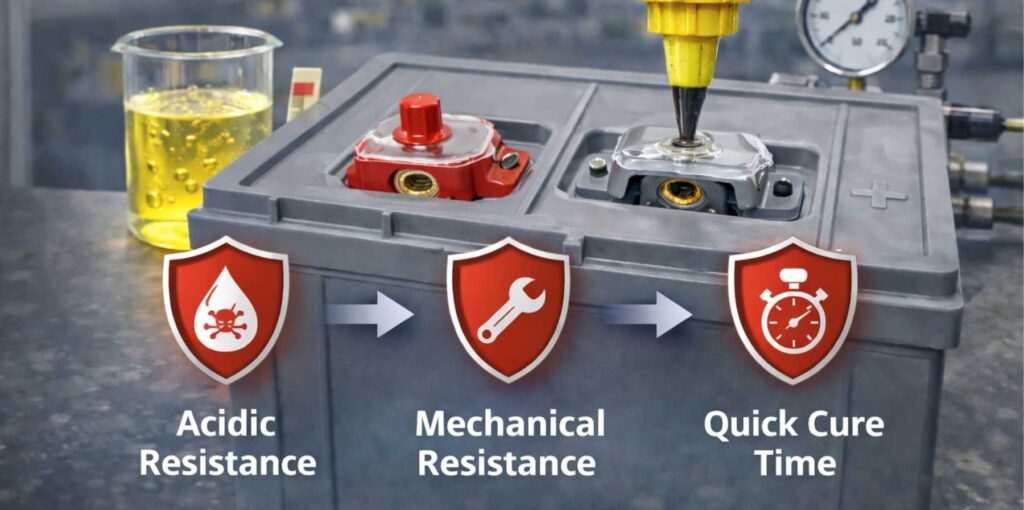
An OEM developing industrial-scale batteries required encapsulation of positive and negative terminal posts within a proprietary enclosure. The potting compound needed to bond reliably to multiple metallic substrates and the enclosure polymer, resist sustained exposure to caustic electrolyte, and maintain sufficient flexibility to tolerate mechanical and pressure-induced stresses. At the same time, the material had to achieve functional cure within minutes, without external heating or bake steps, to integrate into a high-speed automated production environment.
The technical challenge extended beyond material selection, requiring concurrent optimization of cure kinetics, adhesion performance, chemical resistance, and process compatibility.
Customized Solution
Astro Chemical developed the solution through an iterative formulation process supported by structured lab testing. While fast cure was a critical requirement, rapid-reacting systems can become brittle, limit working time, or reduce bonding performance. The development effort focused on balancing cure speed, adhesion, and flexibility so the material could perform reliably within the customer’s production window.
The final formulation achieved handling strength within minutes at room temperature while maintaining strong adhesion across the metallic terminals and thermoplastic enclosure. Special attention was given to long-term bond durability, as differences in surface energy and thermal expansion between materials can affect performance over time.
The encapsulant was validated in a harsh electrolyte environment representative of in-service conditions. Testing confirmed dimensional stability, retention of adhesion, and resistance to degradation that could compromise seal integrity.
During production trials, additional stresses became apparent. Battery testing introduced elevated internal pressures and uneven mechanical loads, creating potential failure points at both the adhesive interface and within the cured material. Targeted formulation refinements and process adjustments improved stress tolerance within the product without sacrificing cure speed. Laboratory validation protocols were aligned with the OEM’s production and testing processes to ensure relevance to real-world outcomes.
Because the battery design required custom dispensing and mixing equipment, Astro worked closely with the equipment manufacturer to ensure material properties were compatible with the automated dispensing processing. On-site technical support was provided during scale-up to verify cure performance, adhesion, and chemical resistance under production conditions.
The resulting encapsulation system integrated seamlessly into a high-speed automated manufacturing line while meeting durability targets for long service life. Several years after launch, the system remains in production and continues to support the customer’s plans to manufacture at scale.
Conclusion
This program demonstrates that success involved more than simply selecting a fast-curing material; it required clearly defining the critical performance properties from the outset. In this application, long-term reliability depended on balancing adhesion, flexibility, chemical resistance, and process compatibility within real-world manufacturing constraints.
By combining formulation expertise with hands-on support during scale-up, Astro Chemical helped the OEM achieve both production efficiency and durable field performance.