Helical Coil Bond Strength Testing for Long-Term Reliability
- Key testing for VPI systems involves electrical, thermal, and mechanical assessments at elevated temperatures.
- These properties are critical to the long-term performance and reliability of high-voltage rotating equipment.
- Astro 5201 is a VPI system with excellent mechanical and electrical properties at temperature.
Vacuum Pressure Impregnation (VPI) resins are insulating and mechanically consolidating coatings applied to the conductive windings of motors and generators. During operation, windings are exposed to repeated centrifugal loading, vibration, and thermal cycling. These forces can produce relative motion between conductors, leading to abrasion, cracking, insulation wear, and eventual electrical failure.
Learn about Astro 5201 High Performance VPI Resin System
VPI resins mitigate this risk by filling voids within the winding assembly and consolidating the entire coil into a rigid, mechanically stable structure. This mechanical consolidation helps stabilize the coil system and reduce movement under service conditions. Helical coil bond strength testing provides a quantitative measure of that mechanical consolidation.
What Is Mechanical Testing for VPA Resins?
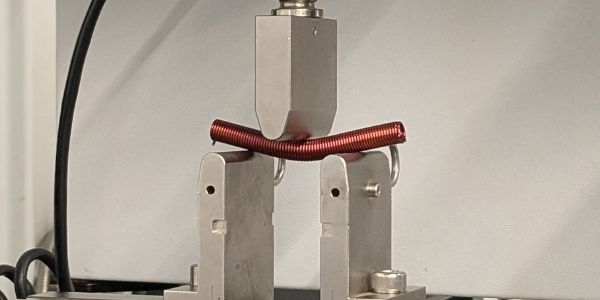
The primary mechanical test used for VPI resins is the helical coil bond strength test. In this test method, coated copper wire is wound around a mandrel to form a helical coil geometry that approximates the winding configuration inside a motor or generator stator. After curing, the coil is subjected to a three-point bend test. Results are reported as a bond strength value in pounds force (lbf) or Newtons (N) and represent the flexural strength: the force required to fracture or de-bond the cured resin within the coil assembly.
Results are typically reported in pounds-force (lbf) or Newtons (N), providing a direct measure of the resin system’s contribution to coil rigidity and mechanical integrity
Applicable Standards
Helical coil bond strength testing is defined in ASTM D2519. The same test geometry and performance metric are used in ASTM D3145, a thermal endurance standard in which retained bond strength after thermal aging serves as the indicator of long-term mechanical durability. Because of this linkage, bond strength data reflects both mechanical performance and thermal aging resistance.
How Mechanical Testing Differs from Electrical Testing
Electrical testing of VPI systems is typically performed on twisted pair constructions designed to evaluate dielectric breakdown and insulation resistance. Mechanical bond strength testing uses a helical coil configuration because it better replicates the physical constraints and stresses inside a stator slot, making it the right method for evaluating bond strength rather than electrical performance.
Temperature and Long-Term Reliability
For machines operating at Class F (155°C) or Class H (180°C), elevated temperature performance becomes especially important. Resin systems that perform adequately at room temperature may soften, embrittle, or lose bond integrity after prolonged thermal exposure.
Example: high temperature VPI resin performance
Some resin systems are specifically formulated for demanding thermal environments.
Astro 5201, for example, is designed to deliver strong mechanical consolidation and electrical insulation performance for motors and generators operating under elevated temperature conditions.